TopicsOverview: Difference between revisions
From Mark Twain in the German Language Press
mNo edit summary |
mNo edit summary |
||
| Line 8: | Line 8: | ||
|include=%0 | |include=%0 | ||
|includemaxlength=200 | |includemaxlength=200 | ||
|listseparators= | |listseparators= , <div class="row overviewBox" style="width:90%; margin:1em auto;"><div class="large-3 columns" style="text-align:center; font-size:1.5em; padding-top:10px;">%TITLE%</div><div class="large-9 columns">,[[%PAGE%|...read more]]</div></div>, | ||
|ordermethod=title | |ordermethod=title | ||
|resultsheader = <i>There are %PAGES% entries in this collection.</i> | |resultsheader = <i>There are %PAGES% entries in this collection.</i> | ||
}} | }} | ||
Revision as of 08:18, 14 July 2025
All pages with additional information on people, places, and topics are collected here. There are additional Overview Pages collectiong entries on people and places respectively. Entries are sorted alphabetically.
There are 68 entries in this collection.
Mit formvollendeten Uebertragungen aus dem Englischen hat Frau Kirchstein sich den Besten des deutsch-amerikanischen Dichterhimmels ebenbürtig zur Seite gestellt. Wie sie die zwingende Stimmung und den packenden Rhythmus des Poeschen "Raben" meistert, das reicht an die geniale Uebertragung durch Dr. Ernst Schmidt heran. [With her perfectly formed translation from English, Ms. Kirchstein has placed herself on an equal footing with the best of the German-American poets. The way in which she masters the compelling mood and the gripping rhythm of Poe's "Raven" comes close to the ingenious translation by Dr. Ernst Schmidt.]
More information on Mark Twain and the Anti-Imperialist League can be found in Jim Zwick's scholarly publications.
In American Doctors and German Universities, Bonner writes about the Association:
Americans in Berlin also had their own medical organization. An Association of American Physicians was founded in the city in 1891 under the leadership of the American dentist Willoughby Dayton Miller, who by this time was in charge of dental teaching at the University of Berlin. Also instrumental in establishing the new association were Dr. Fred Weber of Milwaukee and Dr. Judson Daland of Philadelphia. Weekly meetings were held in the Dental Institute to hear lectures on medical topics. This organization lasted two years but there is no record of further meetings or activities after 1893. It was followed by the more successful Anglo-American Medical Association of Berlin, which was organized in 1903 and flourished until the First World War.
(85)
Das Englische Haus became the premier private dining establishment of Berlin: „Die besten Kreise Berlins feierten bei Huster, dessen auf große Gesellschaften eingerichtete „Stadtküche” zur unentbehrlichen Einrichtung selbst des Hofes geworden war; in Seinem „Englischen Haus” in der Mohrenstraße feierte die „gute Gesellschaft” und gab sich die Hautevolee von Industrie und Börse glänzende Feste.” [The best social circles of Berlin celebrated at Huster. Huster’s city kitchen was arranged for large parties and even became an indispensible accommodation to the King’s Court. Englisches Haus at the Mohrenstraße is where the “high society” had their festivals and where the upper crust from industry and the stock market gave themselves magnificent feasts.] Annemarie Lange, Berlin zur Zeit Bebels und Bismarcks (Dietz Verlag, Berlin 1976, pages 507-508).
Samuel Clemens and Charles Langdon met during the Quaker City Excursion in 1867 when Langdon was eighteen years old and quickly came to admire Clemens (see Rasmussen et al. 2:759). This aquaintance eventually led to the first meeting between Clemens and Olivia Langdon in the same year and to their subsequent courtship and marriage.


After the death of his father Jervis Langdon in 1870, Charles took over the family business in coal and lumber (see LeMaster and Wilson, MTE 440). He married Ida Clark and the couple had three children together: a son, Jervis, and two daughters, Julia and Ida (see LeMaster and Wilson, MTE 440). Although Samuel Clemens and Charles Langdon were not always the closest of friends, their family ties - and the Clemens family's frequent summer stays in Quarry Farm in Elmira - resulted in a cordial and mutually respectful relationship. Langdon was present at the death of Olivia Susan Clemens in 1896 and at Clemens' own death in 1910 (see Rasmussen et al. 2:759). Charles Langdon died on 19 November 1916 in Elmira, N.Y..

Back in the US, she continued to study singing and had her stage debut in Norwalk, Ct., in 1906 (see e.g. MD-287 or “Miss Clemens in Concert,” The New York Times, 23 Sep. 23, 1906). She also wrote several books, among them My Father, Mark Twain.
Clara Clemens was the only child of Samuel Clemens to survive him. According to Rasmussen et al., she not only supported her aging father by running his houshold and “advis[ing] him on his social behavior” (2:635), but also “played an important role in the development of her father’s posthumous image” (2:636).
She and Gabrilowitsch had a daughter, named Nina, who was born at Stormfield shortly following Samuel Clemens’ death in 1910. The family eventually settled in Detroit, Mich., where they lived until Gabrilowitsch died in 1936 (see LeMaster and Wilson, MTE 650) and Clara Clemens moved to Los Angeles. In 1944, she married her second husband, the musician Jacques Samssoud (see Rasmussen et al. 2:636).
Clara Clemens died, aged 88, on 19 November 1962 in San Diego, Calif..
...read more
Clemens himself, his wife, and their children are buried in Woodlawn Cemetery in Elmira.
Clara Langdon Clemens wrote about the Quarry Farm summers in My Father, Mark Twain and introduces the location as follows:
The major part of Father’s work was accomplished in the summer, which we spent with my mother’s sister, Mrs. Theodore Crane. She lived on the top of a long hill overlooking Elmira, New York. The place was called Quarry Farm, and was a heavenly spot. On a sunny day one could see the Chemung River sparkling far below as it wound its way through the town of Elmira, nestled cozily between the hills surrounding it. […]
The house […] was simple but very comfortable, with enough rooms to accommodate our family. Susy and I slept together, my younger sister, Jean, roomed with the nurse, and Father and Mother occupied a third room. Mrs. Crane often referred to her home as “Do as you Please Hall,” for she wished everyone to feel complete liberty to act and think as he would.
(59)


Quarry Farm was donated to the Elmira College in 1983 and is now used by the Center for Mark Twain Studies. A virtual tour of the location is available on the Center for Mark Twain Studies website.
Jervis Langdon, father of Olivia Langdon Clemens, first purchased a family plot in Woodlawn Cemetery in 1866 (see Jerome and Wisbey 143) and when Olivia and Samuel Clemens’ first child, a son named Langdon, died in infancy in 1872, he was buried in the Langdon cemetery plot establishing the place as a shared grave site for the Langdon and Clemens families alike (see Selby 19).
Whereas the inscription on Clemens’ own gravestone is quite short, those on the gravestones of his daughters and his wife are longer and include poetic quotes or personal farewells.
 "SAMUEL LANGHORNE CLEMENS
 MARK TWAIN
 NOV. 30, 1835-APR. 21, 1910"

 "IN THIS GRAVE
 REPOSE THE ASHES OF
 OLIVIA LANGDON
 THE BELOVED AND LAMENTED WIFE OF
 SAMUEL L. CLEMENS
 WHO REVERENTLY RAISES THIS STONE
 TO HER MEMORY
 ELMIRA, NOV. 27, 1845
 FLORENCE, ITALY, JUNE 5, 1904
 'GOTT SEI DIR GNÄDIG, O MEINE WONNE!'"

 "IN MEMORY OF
 JEAN LAMPTON CLEMENS
 A MOST DEAR DEAR DAUGHTER
 HER DESOLATE FATHER
 SETS THIS STONE
 'AFTER LIFE'S FITFUL FEVER
 SHE SLEEPS WELL'
 JULY 26, 1880-DEC. 24, 1909"

 "OLIVIA SUSAN CLEMENS
 MAR. 19, 1872-AUG. 18,1896
 'WARM SUMMER SUN
 SHINE KINDLY HERE
 WARM SOUTHERN WIND
 BLOW SOFTLY HERE
 GREEN SOD ABOVE
 LIE LIGHT; LIE LIGHT
 GOOD NIGHT; DEAR HEART,
 GOOD NIGHT, GOOD NIGHT'
 ROBERT RICHARDSON"

 "CLARA CLEMENS
 GABRILOWITSCH
 SAMSSOUD
 JUNE 8, 1874-NOV. 19, 1962
 GOOD-BYE DARLING
 UNTIL WE MEET AGAIN"
(Jean, Susan, and Clara's inscriptions as quoted in Selby 19)
After returning to Germany in 1875, Hopp maintained his interest in the United States and continued to write about American life, history, and culture. Some of his journalism was printed in German-American newspapers in the 1880s and 1890s. Hopp was a prolific author and wrote extensively about the United States, publishing numerous books on a wide variety of topics. In his 1876 article "Die humoristische Poesie der Amerikaner" ["The Americans' humorous poetry"], Hopp translated representative poems by Oliver Wendel Holmes, John Saxe, James Russell Lowell, and other writers (60-68). His book Unter dem Sternenbanner: Streifzüge in das Leben und die Literatur der Amerikaner [Under the Star-Spangled Banner: Forays into American Life and Literature] (1877) devotes a chapter to the humorous poetry of Bret Harte and Joaquin Miller (3-60), but contains no mention of Mark Twain.
Mähliss was a member of the "Verein für vereinfachte Rechtschreibung" [Association for Simplified Spelling], founded in 1876, and editor of the journal Ortografen (Klenz 1050), which advocated for a radical reform and perceived "simplification" of German spelling. In a short critical review of Mähliss' text, Th. Matthias refers to Mähliss' efforts to convert passages from Goethe's Wilhelm Meisters Lehrjahre into his new proposed spelling and grammar unfavourably as a "Verballhornung" (54) of the German language, an idiomatic expression which at the time was used to describe the effort of trying to improve something while actually making it worse.
Further sources:

The public crowded the church for a last opportunity to see the famous Mark Twain and the viewing, according to the New York Times, took one and a half hours as approximately 3,000 people passed through the church (see “Last Glimpse Here of Mark Twain,” The New York Times, 24 April 1910).
Clemens’ body was dressed in a white suit - the style he had preferred to wear during the last years of his life (see Paine Biography 3:1579). The funeral service followed on 24 April, conducted at the Langdon family home in Elmira by Samuel Elijah Eastman, in the same place where Clemens and Olivia Langdon had gotten married in 1870. It was a simple service for which only family and close friends were present. Clemens was buried in Elmira’s Woodlawn Cemetery, next to his wife and three of his four children.


The Illustrated London News published the text in three instalments, September 4, 1892, October 1, 1892, and October 22, 1892. This time, it was accompanied by ten original illustrations created by Amédée Forestier (1854-1930), an artist who, at the time, enjoyed great popularity with readers of English books and magazines and who also garnered respect for his artistic technique (Sketchley 93).
“The German Chicago” was later included in several collections of Mark Twain’s works, for example in The £1,000,000 Bank-Note, and Other New Stories (1893, 210-232), The American Claimant and Other Stories and Sketches (1898, 502-517), and In Defense of Harriet Shelley, and Other Essays (1918, 244-262).
Sources:
- Brümmer, Franz, "Beaulieu, G. von." (in Bettelheim 219).
- Lohde, Clarissa, "Gertraut Chales de Beaulieu." Berliner Tageblatt und Handels-Zeitung, Abend-Ausgabe, January 24, 1903, 7.
Preliminary Sources:
- German Wikipedia page
- English Wikipedia page
- Brockhaus Konversationslexikon, Berlin und Wien, 14. Auflage, 1894-1896

There seems to be no record of why Heidelberg was chosen as a temporary place of residence. Since Clemens was looking for a location to withdraw from the hassle of life in Hartford, he might have found it appealing to hear about Heidelberg offering “a peaceful state of rest and content” – a phrase that Charles Dudley Warner, his next-door neighbor and a collaborator on The Gilded Age, had used in his travel book Saunterings (1872, 43). Similarly, the American poet Bayard Taylor had envisioned Heidelberg as “a place for rest and quiet study” (56) in his book Views A-Foot (1846, rev. ed. 1872). Clemens had been in touch with Taylor since 1877 (Kersten, 253). Now his trip to Europe aboard the steamship “Holsatia” afforded him the opportunity to spend the two-week voyage from New York to Hamburg in close proximity to Taylor, who was en route to begin his term as America’s German envoy.

A letter written in February 1878 mentions Dresden as a possible place for a longer stay (MTHL I, 220), but the idea never materialized. In March Clemens wrote to Mary Fairbanks that he wanted to “find a German village where nobody knows my name or speaks any English” (UCCL 01542). Even shortly before the departure of the “Holsatia,” he informed a New York Times reporter that he was “going to the most out-of-the-way place in Germany I can find [...] fifty miles away from any railroad” (Scharnhorst 2006, 15). Upon their arrival in Hamburg, however, the Clemens family contemplated Heidelberg as a potential destination for an extended stay. “We shall [...] go to Heidleberg [sic] where we shall probably stay nearly two months” Olivia wrote to her mother on April 26 (from Olivia Langdon Clemens to Mrs. Jervis Langdon, original letter at the Mark Twain Project).
The Clemens family arrived in Heidelberg, a city of approximately 28,000 inhabitants (Luks, 86), on the afternoon of 6th May 1878. Until now, German newspapers, even with digital reproductions available, have provided little assistance in reconstructing Clemens’s visit to Heidelberg. It appears that there is only a single reference to his presence in the city. The Heidelberger Zeitung printed a list of newly arrived visitors (“Fremdenliste”) in the city, including the line “Hotel Schrieder [...] Clemans [sic] und Fam. a. New-York” (7 May, 1878, 4).

Hotel Schrieder had a long history in Heidelberg and advertized itself as a first-class hotel (see image left). In July 1877, it had accommodated former US president Ulysses S. Grant and his wife (see Der Landbote, Anzeiger für den Amtsbezirk Sinsheim und Umgebung, 21 July, 1877, 2). But something must have troubled the Clemens family to such an extent that Olivia referred to it “a most miserable hotel” (Snedecor 104), prompting Clemens to quickly move them to better quarters at the Schloss-Hotel, a relatively new hotel located near the famous Heidelberg Castle.


Heinrich Albert is credited as “of the best innkeepers and an expert on tourist life in the grand style,” a characterization that corresponded to Olivia Langdon Clemens’s first impression of him, as he treated her and the children as an attentive and hospitable host. After moving there from what she perceived to be the much worse Hotel Schrieder, the new accomodation at the Schloss-Hotel pleased Olivia greatly. In her early letters she called the location “a perfect Paradise” (Snedecor 102) and “the most lovely place that anyone ever saw” (104).

Source: A Tramp Abroad, Twain, 1880 (page 28). Public domain, https://archive.org/details/trampabroad00twai/page/28/.“This hotel had a feature which was a decided novelty, and one which might be adopted with advantage by any house which is perched in a commanding situation. This feature may be described as a series of glass-enclosed parlors clinging to the outside of the house, one against each and every bed-chamber and drawing-room. They are like long, narrow, high-ceiled bird-cages hung against the building. My room was a corner room, and had two of these things, a north one and a west one.” (A Tramp Abroad 28)
Clemens also felt that they were “divinely located” (MTHL I, 229). He was fascinated by the enclosed balconies attached to their bedroom which he described in a letter to Howells as “two great bird-cages” which gave them a spectacular view of Heidelberg and the Rhine valley. He also found the quiet seclusion he sought during his European stay. “Lord, how blessed is the repose, the tranquility of this place,” he wrote to Howells (MTHL I, 230). It may have been a result of the fact that, as Olivia wrote to her mother, “no one in the hotel knows who Mr. Clemens is” (Snedecor 103).
After graduating from Princeton Theological Seminary, he spent a few years in Europe, studying and travelling (see "Henry Van Dyke" 20). In 1883 he was called as pastor to the Presbyterian Brick Church in New York. He was a prolific writer of novels, essays, poetry, and theological treatieses (see "Henry Van Dyke" 21), and, from 1900 to 1923, professor of English literature at Princeton University (see "Henry Van Dyke" 20). Van Dyke met Samuel Clemens regularly at formal occasions as they both frequented many of the same social circles (see Rasmusssen et al. 2:923). Clemens admired Van Dyke's writing and they became friends. Eventually, Van Dyke officiated at Clemens' funeral service at Brick Church in New York City (as did Joseph Hopkins Twichell. Van Dyke himself died on 10 April 1933 in Princeton, N.J..
An English translation of Der Habermeister was published in 1869: The Habermeister: A tale of the Bavarian Mountains. Translated from the German of Herman Schmid. New York: Leypoldt & Holt, 1869. [Source: New York Herald, June 18, 1869]. The Chicago Tribune printed a brief review of the book on 17 July, 1869.
Information about the meaning of “Habermeister” and “Haberfeldtreiben” is available in Brockhaus Konversationslexikon (Leipzig, Berlin und Wien, 14. Auflage, 1894-1896, Vol. 8, p. 619).
The newspaper Freie Presse für Texas printed an obituary on 6 Nov., 1880.
Preliminary sources:
- English Wikipedia page
- Very detailed biographical entry in Deutsche Biographie
- Biographical entry at Literaturportal Bayern
- Selected publications in digital format (including Der Habermeister)
- Various materials collected in Bavarikon

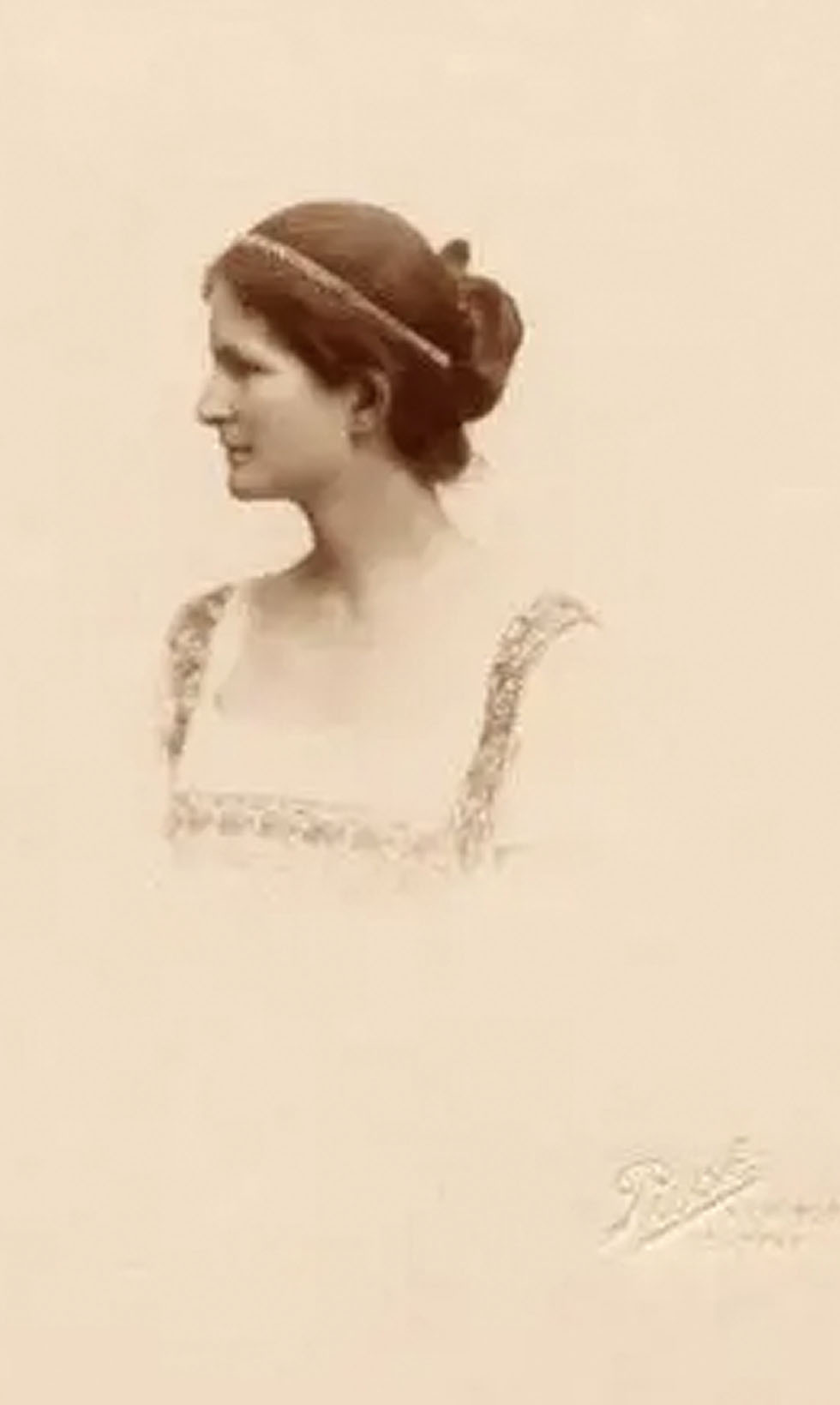
Being the focus of so much attention, especially from her father and increasingly after the death of her older sister Susy, was a huge source of stress for the young woman who had little opportunity to find personal fulfilment or engage in activities away from her family (see Rasmussen et al. 2:638). For a time, she was very involved in animal welfare activism (see Rasmussen et al. 2:638) and supported different groups with this aim.
Her epilepsy worsened in 1904 - after the death of her mother and a riding accident which left her seriously injured - and she was again forced to spend a lot of time on managing her health. Starting in autumn 1906, she entered various sanatorium and, in 1908, travelled to Germany for treatment. During this time, Jean Clemens felt increasingly estranged from and neglected by both her father and her sister Clara (see Skandera-Trombley 179-180). She did not return to live with her father until April 1909 (see Skandera-Trombley 16), when she moved in at Stormfield in Redding, Ct., mostly to do secretarial work.
Stormfield was the place were, on 24 December 1909 (only a few month after she had moved in), Jean Clemens died - presumably from a heart attack during a seizure. Her father, distraught by this latest family tragedy, did not attend her funeral. He wrote “The Death of Jean” as a tribute to her. Like her brother Langdon, sister Susy, and her mother before her, Jean Clemens was buried in the family plot at Woodlawn Cemetery in Elmira, N.Y..
Hartford was also the place where he first met Samuel Clemens and they soon established a close friendship, in which “Twichell not only tolerated Clemens’ irreverence, profanity, and occasional salacious humor; he enjoyed them” (MTE 757). Twichell and Clemens repeatedly travelled together and, according to Rasmussen et al., the long-lasting friendship had a considerable impact on Clemens’ work as Twichell “encouraged Clemens through difficult periods, and fed him ideas and shared experiences that his friend wrote about” (2:919).
As a family friend, Twichell also officiated at many ceremonies for the Clemens family, for example at Samuel and Olivia Langdon Clemens‘s wedding and at the wedding of Clara Langdon Clemens and Ossip Gabrilowitsch, as well as at the funerals of Clemens’ daughters Susy and Jean and of his wife Oliva (see Rasmussen et al. 2:918-920). After Clemens’ own death, Twichell conducted the funeral service in New York City but could not officiate at the other ceremonies because his wife was seriously ill and died shortly after (see Rasmussen et al. 2:920).
Twichell died on 20 December 1918 in Hartford, CT.
Some examples for newspaper reprints are:
- “Mark Twain Settles It,” Worcester Daily Press (Worcester, Mass.), 27 July 1876;
- “The Secret Out,” The Kenosha Telegraph (Kenosha, Wis.), 03 Aug. 1876;
- “Postal Economics. The Secret of Jewell’s Removal Revealed by Mark Twain,” The Cheyenne Daily Leader (Cheyenne, Wyo.), 04 Aug. 1876;
- “The Secret Out,” Bismarck Weekly Tribune (Bismarck, D.T.), 13 Dec. 1876.
Throughout her life, Lucy Hayes showed interest in a number of charitable causes and political activities which supported her husbands social standing and political career. She was applauded by some - and ridiculed by others - for her decision to stop serving alcohol in the White House and countless temperance groups nation-wide saw her as an ally in their fight for abstinence and even prohibition, even though Lucy Hayes repeatedly distanced herself from the more extreme sentiments of the temperance movement (see Greer).
...read more
The first German translations of the story appeared shortly after the initial publication. Notably, Udo Brachvogel’s translation appeared in several daily newspapers in Germany, including in Dortmunder Zeitung (Sep 23, 1880, 2), in Lippische Landes-Zeitung (Sep 29, 1880, 2) and twice in the supplement to Halle’sches Tageblatt (October 12, 1800, 1 and October 13, 1800, 1). Several years later, excerpts from the story were published under the title “Das Gewitter” in Düsseldorfer Volksblatt (Oct 29, 1882, 6), and Wittener Volks-Zeitung (Nov 5, 1897, 2). In later years, some newspapers also announced readings of the story to be broadcast on German radio stations (for example Deutsche Allgemeine Zeitung, Jan 29, 1926, 3).
A digital version of Mark Twain's original note is available via the Digital Collections of the New York Public Library as part of the Henry W. and Albert A. Berg Collection ("Notice to the next burglars, and Affidavit to the court identifying silver." The New York Public Library Digital Collections. 1908. https://digitalcollections.nypl.org/items/16f08500-efc0-012f-c6f0-58d385a7bbd0).
Olivia Langdon’s health was frail throughout her life and over the years there has been a lot of speculation on the nature of her illness. A reasonably well supported assumption is that she had Pott’s Disease (tuberculosis of the spine), probably starting from age 14 (see Rasmussen et al. 2:642). She spent some of her teenage years receiving extensive treatments for her condition.


In his autobiographic dictations, Samuel Clemens included the story of how he first fell in love with Olivia merely by seeing her picture, an ivory miniature which her brother, Charles Jervis Langdon, showed to him during the Quaker City Excursion in 1867. Later that year, at a Quaker City Christmas reunion in New York, Olivia Langdon and Samuel Clemens first met in person at a dinner and Clemens proceeded to court her over the following year, visiting her in Elmira and writing her numerous letters (see Rasmussen et al. 2:642). Olivia Langdon refused a first marriage proposal but eventually accepted a second one. The marriage ceremony followed on 2 Feb. 1870.
The couple initially moved to Buffalo, NY, where Jervis Langdon bought them a house and had it furnished and staffed as a wedding present to his daughter and her husband (see MTE 156). Yet, Buffalo did not turn out to be a happy place for Samuel and Olivia Clemens. Olivia’s father died in August 1870 and her first son, Langdon, was born prematurely after a near-miscarriage in November. Both of these events seriously impacted her health; she contracted typhoid fever as did Langdon, and - only a year after moving to Buffalo - Samuel Clemens decided to take her back to her family in Elmira (see Rasmussen et al. 2:642). Their son Langdon did not survive infancy; he died in 1872.
The young family’s next home would be in Hartford, Conn., but regular stays at Elmira would remain part of their family life for years and all three of the Clemens daughters were born on Quarry Farm in Elmira: Olivia Susan (Susy) in 1872, Clara in 1874, and Jane Lampton (Jean) in 1880.
Olivia Clemens accompanied her husband on numerous voyages, probably most notably his world lecture tour from 1895-1896, and the family lived abroad on multiple occasions (see MTE 157). When Olivia Clemens’ health began to decline dramatically in 1902, the family sought out warmer climates to accommodate her. During this time, Olivia was often isolated from her family - a recommendation by her doctors to keep her from any stressors and excitement. A move to Florence, Italy, in 1903 was also intended to support her health. On 5 June 1904 she died there, presumably from heart failure; her remains were transported to Elmira and buried in Woodlawn Cemetery.
Throughout her life, Olivia Clemens supported her husband, in their daily private life as well as in matters of his career. She was a proof-reader and editor of his works and of course managed the family’s home life. Financially, her inheritance from her father was the main source of the family’s wealth for many years. The money enabled them to live comparatively lavishly and gave Samuel Clemens the opportunity to publish according to his own pace and interests, as well as to invest in various business enterprises (see Rasmussen et al. 2:643). In 1894, when one of these businesses - the publishing house Charles Webster & Company - went bankrupt, Olivia Clemens was recognized as a primary creditor and had her husband’s copyrights assigned to her name, saving them from falling to someone outside the family (see Rasmussen et al. 2:586).
As a child, she began writing a biography of her father who later included some of the material (and his own commentary on it) in his Autobiography (see Rasmussen et al. 2:644).


Olivia Susan Clemens attended Bryn Mawr College for a short time and later accompanied her family to Europe from 1891-1895. She decided to stay with her youngest sister Jean in Elmira for their father’s international lecture tour from 1895-1896. Towards the end of the tour, in August 1896, Olivia Susan Clemens contracted spinal meningitis and her health deteriorated rapidly over the next couple of days. While her parents knew that she was ill and her mother and sister Clara quickly decided to return home to be with her, they did not realise the severity of the situation, nor did they reach Elmira in time before Olivia Susan died on 18 Aug. 1896 (see Rasmussen et al. 2:644).
The unexpected death devastated the family and led to them giving up their home in Hartford, where Olivia Susan had died (see MTE 158). She was buried in the Langdon-Clemens family plot in Woodlawn Cemetery, Elmira.

The couple decided to live in Europe, where Gabrilowitsch had a promising career as a pianist and conductor. They returned to the US briefly in 1910 to be with Samuel Clemens when he died, to arrange his funeral, and to close down the house. The Gabrilowitsch’s only child, a girl named Nina, was born during this time at Stormfield.
Back in Europe, Ossip Gabrilowitsch resumed his work as a conductor in Munich for a few years before the beginning of the First World War convinced him to return to the US with his wife and daughter. There, he worked for the Philadelphia Symphony and later the Symphony Orchestra in Detroit, earning enough to “allow Clara to save what she received from her father’s estate” (Rasmussen et al. 2:693).
Ossip Gabrilowitsch died on 14 Sep. 1936, aged 58, from stomach cancer and was buried in Woodlawn Cemetery, Elmira.
During Mark Twain's visit to the Austrian Parliament on 28th October 1897, Lecher infamously held a speech which went on for twelve hours.
The names' nautical origin (literally meaning "two marks" or 12 feet in measuring the depth of a river) were repeatedly explained to the general public in newspaper reports - sometimes in the form of a short article merely professing to present an interesting tidbit of information, sometimes in the form of longer musings and anecdotes about Clemens' life and his time as a Mississippi pilot.
"Mark Twain" was not the only pen name Clemens used, but it was the one he used most consistently in his publications (and sometimes in his private life) and which most shaped the perception of his public persona. Newspaper articles frequently mention both names (S. L. Clemens and Mark Twain) for clarity, but often use only Mark Twain to refer to the Clemens.
There were a number of producers of similar protein products around the time (see “New Foods and Cures” in the Conchise review, 10 Oct. 1900 which uses “albumen” as a catch-all term for this and similar products). An extensive advertising campaign claimed that Plasmonhad been invented by German Chemist Dr. Siebold in (see for example “Plasmon, a Nutritious Food,” The San Francisco call, 5 Mar. 1901, 9). The production of Plasmon was cheap and Clemens therefore deemed its marketization a profitable business opportunity. The powder would be dissolved in boiling water, baked into biscuits, or cooked into all sorts of food to make it palatable.
Around the time, Clemens consumed it on a daily basis in some form, either dissolved in milk or simply eaten as plain powder (Paine 3:1099, 3:1151). He also promoted it to family and friends as a miracle cure which he claimed had healed him from indigestion and which he hoped would also improve the declining health of his wife, Olivia (Ober 172). In terms of nutrition, Plasmon was claimed to equal a multiple of its weight “in steak”, not only by Clemens but also by some of his contemporaries (Ober 171).
...read moreClemens participated in the excursion as a newspaper correspondent for the San Francisco Alta California and therefore did not have to pay the $1,250 per-person fare (see Rasmussen et al. 2:845). Initially, the planned participation of notable personalities, like General William Sherman and Rev. Henry Ward Beecher, was advertised to attract more passengers, but the scheme back-fired when both Sherman and Beecher, as well as a number of passengers from Beecher’s congregation and other minor celebrities, announced they would not be joining the excursion after all (see Ganzel 13-15). Clemens remained as the only person of at least some public interest and, according to Ganzel, enjoyed his status as a “celebrity” (16) among the travelling party, which was - with the exception of Clemens himself - mostly wealthy and from the East Coast (see Ganzel 16).


The ship left New York on 8 June 1867 and “[the] voyage lasted 164 days, of which 46 were spent on the Atlantic and 118 on the Mediterranean and Black seas. While the ship was in the Mediterranean, Clemens spent roughly 66 days ashore” (Rasmussen et al. 2:847-848). The date of return was on 19 November 1867. The cities visited included Paris, Genoa, Naples, Constantinople, Jerusalem, Alexandria, and many others - and visits could be skipped or additional tours added by the participants as desired. During the excursion, Clemens spent considerable time writing the required travel letters for the San Francisco Alta California and he would later draw on these letters to write his book The Innocents Abroad.
Clemens arranged for John Mead Howells to design a house to be built on the property (see Paine Biography 3:1446). This would eventually become Clemens’ permanent home, which he called “Stormfield” (see Rasmussen et al. 2:852), named after his character Captain Stormfield.
The Redding community welcomed the famous author: when he arrived in 1908 to settle in his new home, a crowd of people greeted him at the train station and accompanied him on his way to Stormfield. Once he was fully settled in his new home, Clemens got involved in local affairs and sought out the Redding community (see Rasmussen et al. 2:852). One community project he was especially supportive of was the “Mark Twain Library of Redding” to which he contributed books and for which he raised funds (see Rasmussen et al. 2:852).
Clemens lived in Redding until his death in 1910.
The design Howells settled on was an Italian style villa overlooking the surrounding area. The two-story house had eighteen rooms, water supplied by a natural spring on the property, electric lights, and a steam generator for heat (see Rasmussen et al. 2:902-903).
Initially, Stormfield was intended only as a summer home and Clemens kept his apartment in New York City, but shortly after his first arrival in Redding in 1908 he decided that he would settle there permanently; the tranquillity and calm of the countryside suited him so well.
Clemens referred to the house as “Autobiography House” for a while, acknowledging that the funds to build it came from his successful publication of “Chapters from my Autobiography” in the North American Review (see Rasmussen et al. 2:903). Later he called the place “Innocence at Home” - a reference to the “Angelfish” girls - and eventually renamed it Stormfield - in reference to “Extract from Captain Stormfield’s Visit to Heaven” the sales of which had contributed to finishing the house. Overall, building and furnishing Stormfield cost about $60,000 (see Rasmussen et al. 2:903).

Time at Stormfield passed leisurely with Clemens taking walks through his gardens, playing billiards or cards with visitors, and reading (see Paine Biography 3:1460), and the quiet of everyday life was especially apparent compared to the perpetual travel and prolific literary activity of the preceeding years. Yet Stormfield also saw considerable family upheaval in the following months. In 1909, the marriage of Clara Clemens and Ossip Gabrilowitsch was celebrated at Stormfield and only a few months later Jean Clemens tragically died there. Clemens himself died on the property in April 1910 and Clemens’ only grandchild, Nina, was born in the house about four months later. Afterwards, Stormfield was closed down by Clemens’ only surviving daughter Clara (see Rasmussen et al. 2:903) as she and her family decided to move back to Europe.
The Library of America’s Story of the Week article on the sketch elaborates on the historical context:
The 1870 New York gubernatorial election pitted the Democratic incumbent, John T. Hoffman, against the Republican, Stewart Lyndon Woodford, a decorated Civil War veteran and former lieutenant governor. Previously the mayor of New York City (the last to become governor of the state), Hoffman was closely connected with Boss Tweed’s Tammany Hall political machine and won the election with over 52% of the vote. Two years later, however, Hoffman would be drummed out of office after The New York Times ran a series of exposés on Tweed’s corrupting influence over regional politics and the embezzlement of tens of millions of dollars in taxpayer funds.
What’s not as well known about the 1870 election is Mark Twain’s brief entry into the race for governor—at least in an imaginative piece published shortly after the election. ‘Running for Governor’ appeared as his monthly column for Galaxy magazine and in the local Buffalo Express newspaper, and it was thereafter widely reprinted. (In some versions, the names of the major party candidates were changed to ‘John T. Smith’ and ‘Blank J. Blank.’) It would not be the only time Twain mocked Governor Hoffman in his writing. The following year he published Mark Twain’s (Burlesque) Autobiography and First Romance, which included illustrations that had nothing to do with the text: caricatures of various robber barons and politicians (including Hoffman) captioned with lines from the nursery rhyme ‘The House that Jack Built.’ Two years later Twain had second thoughts about the book as a whole, considering it one of his lesser efforts, and had the plates destroyed.
(Story of the Week: Running for Governor)
Many years after the text's first circulation in the US, it became the cause of some confusion in the German press. A number of German journalists had difficulties understanding the satirical tone of the piece and mistook fiction for factual reporting. The partial translation and commentary printed in the Berliner Börsen-Zeitung, 11 Sep 1880, 8, provides the reader with little assistance in determining the reliability of Mark Twain's descriptions. An article in Baltimore's Der Deutsche Correspondent on October 7, 1880, (MD-035) complains about the "fabelhafte Dummheit" (fabulous stupidity) with which some of Germany's larger newspapers treat the election satire as a true story.
Selected Contemporary Reactions:
- “Mark Twain and Ex-President Harrison on the Philippine Policy.” The Literary Digest, Vol. XXII, No. 8 (February 23, 1901): 217-219.
- “Among the Periodicals.” The International Socialist Review, Vol.1 (1900-01): 581-582. Calls it "one of the most scathing and sarcastic reviews of capitalism that has appeared in many a day."
- “Mark Twain on the Philippine Problem.” The American Monthly Review of Reviews, Vol. 23 (Jan-Jun. 1901): 339-340.
Related Items:
- Mark Twain. “To My Missionary Critics.” The North American Review, Vol. 172, No. 533 (Apr. 1901): 520-534.
- Mark Twain and His Critics.” The American Monthly Review of Reviews, Vol. 23 (Jan-Jun. 1901): 622.
A digital version of the typescript of the text with additional pencil sketches, holograph inscriptions, and explanations is available via the New York Public Library Digital Collections (Henry W. and Albert A. Berg Collection of English and American Literature, The New York Public Library. "The Cradle of Liberty. Typescript with pencil sketches with holograph inscriptions and explanations." The New York Public Library Digital Collections. 1892. https://digitalcollections.nypl.org/items/afd13ce0-f139-012f-9872-58d385a7b928).
Barbara Schmidt’s Twainquotes has a transcript of the article as it appeared in the Chicago Daily Tribune on March 6, 1892.
Carl Dolmetsch wrote extensively about Twain's stay in Austria in Our Famous Guest (1992).

On October 16, 1898, the Austrian daily newspaper Neue Freie Presse reported that Mark Twain arrived at the Hotel Krantz from Kaltleutgeben with the intention of spending the winter in Vienna (see image). Although the hotel had opened only a few months before Mark Twain's arrival, it had already earned a good reputation. It was described as comfortable and known for serving good food and drinks. This reputation was also reflected in the guest book, which listed such illustrious names as His Royal Highness the Prince Regent of Bavaria and the Duke of Oldenburg, Hereditary Grand Duke of Baden, Hereditary Prince of Hohenzollern, Prince Albert of Belgium, Duke Günther of Schleswig-Holstein (see "Hotel Krantz," Neue Freie Presse, 16 Oct. 1898: 4:2-3).
In letters to Henry H. Rogers, Clemens reports that the new hotel had offered him a stay because the owner saw his presence as "the best advertisement they could have" (Leary 360). This put the writer in a position to successfully negotiate a lower monthly rate, leading him to ultimately decide to stay at the hotel which he called a "palace" (Leary 355), "completely and richly furnished like the Waldorf." The suite he and his family occupied included "a dining room, a parlor, a music room, a study, and 4 bedrooms — with bathrooms attached to 3 of the bedrooms" (Leary 360). Months before Clemens and his family moved into the hotel, the owner had displayed in the lobby "the finest portrait" of him that his wife had ever seen. "We don't know who made it nor when, but we recognize that it is a hotel that has taste," Clemens joked (Leary 356). Apparently, Clemens got along well with the owners, because when Joseph and Marianne Krantz celebrated their silver wedding anniversary at the hotel, Sam, Olivia, and their daughters attended. The Neue Freie Presse reported that "der illustre Schriftsteller" ("the illustrious writer") joined the celebration and offered words of congratulation to the couple ("Mark Twain als Gratulant," NFP, Nov 15, 1898, 6:2). For more information on the Hotel Krantz, see Dolmetsch 241-243.
In June 1945, the luxury hotel was renamed "Hotel Ambassador". More information about the history of the hotel is provided on the hotel's website.

The text of the speech can be found in Mark Twain Speaking (Fatout, 173-175). Coverage of this event in the American English-language press can be found for example in the Evening star ("A Speech by Mark Twain," December 23, 1882, 6) and The Republican ("Woman, God Bless Her!" December 30, 1882, 5).
Excerpts of the speech made it into German-language newspapers in the US and Europe as well. Many of the articles published in the German-language press are identical, for example those from Dresdner neueste Nachrichten (19 Jan. 1904, 6), or Hannoverscher Courier (18 Jan. 1904, 2), and the specific report on Mark Twain's speech which they all reference as their source text was published in Neues Wiener Tageblatt (13 Jan. 1904, 9).